
Ludonarrative dissonance occurs when a tabletop RPG’s mechanics and narrative intent conflict. It is one of the most important concepts in TTRPG game design theory, and one of the least discussed outside dedicated design communities. This post looks at what ludonarrative dissonance means in practice, examines examples from Vampire: The Masquerade, Legend of the Five Rings, Call of Cthulhu, and Blades in the Dark, and explores how ludonarrative harmony can be designed intentionally. It also covers how these principles are directly shaping Myth: Forgotten Legends, an original TTRPG currently in development at Weald Path Studio.
What Is Ludonarrative Dissonance?
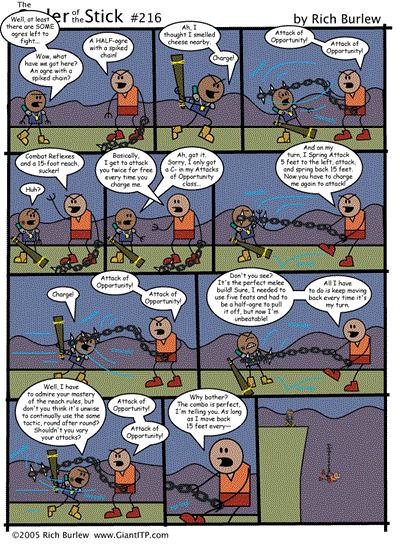
Ludonarrative dissonance occurs when a game’s mechanics and its narrative or thematic intent pull in opposite directions. Most players are intuitively sensitive to this, even without knowing the term. A huge battle axe dealing more damage than a small dagger just makes sense. No explanation needed. It works. But the opposite is equally obvious: when something doesn’t work the way it should, players feel it immediately.
I first became aware of it after watching a video essay on YouTube by a creator called Spice8Rack, where he explored ludonarrative theory in the context of Magic: The Gathering. He talked about how card mechanics represent aspects of the story, and how the rules of a particular card should capture not just its function but its art, its lore, and the world it draws from. This resonated deeply, and I found myself thinking about how ludonarrative harmony and dissonance show up across all the games I play, and also how I can apply it to the game I am writing, Myth: Forgotten Legends and indie TTRPG design in general.
One example comes from one of my favourite games: Vampire: The Masquerade. The game presents itself as a story about vampires clinging to their humanity as their inner beast pushes them toward their base urges. In practice, however, violence is not only effective but satisfying to execute mechanically. There are no real rewards for avoiding evil acts and no meaningful consequences for indulging your darker nature. You would have to actively work to lose your humanity altogether, and it turns out vampires are simply very good at solving problems with violence. The theme says one thing; the rules say another.
When Ludonarrative Harmony Works
It would be easy to fill this entire post with examples of dissonance. But what can we actually learn from this? The good news is that many games have already done the hard work, building mechanics that don’t just represent their world but actively support the story being told.
The honour mechanic in Legend of the Five Rings is one of the strongest examples in TTRPG design. Characters gain and lose honour based on their actions, and this has tangible effects on how others in the rigid, ritualistic society of Rokugan perceive them and on how they perceive themselves. Act against your character’s upbringing and expectations, and you will find yourself scorned, unable to access certain abilities, and eventually compelled to commit seppuku if honour falls far enough. This mechanic is unique to L5R, but more importantly, it reinforces one of the game’s core pillars, producing a tone and feel that remain consistent with the story and lore.
Lethality and high-consequence gameplay offer another strong lever for ludonarrative design. A heroic fantasy game might make death or serious failure relatively difficult to achieve, ensuring players feel powerful, assertive, and capable. A horror game might remove those safety nets entirely so that players feel hunted, cautious, and fragile. A grittier, more realistic system might mean that a single missed parry ends a character’s life. The stakes aren’t just flavour. They are mechanically enforced.
Outside of combat, mechanics that open entirely new dimensions of play will always reinforce the themes they focus on. Call of Cthulhu‘s sanity mechanic keeps players acutely aware of the psychological toll of what their characters experience. Blades in the Dark‘s flashback system, stress mechanics, and progress clocks build a tense, powder-keg atmosphere that is always ready to explode.
Designing Myth: Forgotten Legends and Narrative Game Design
For Myth: Forgotten Legends, I knew from the start that I wanted mechanics to actively reinforce the game’s core vision. Coming from a marketing background, my first instinct was to create a brand guide I could reference throughout the design process. In practice, that didn’t really work. Rules kept evolving, ideas that once fit no longer did, and the game grew in ways I hadn’t anticipated.
That growth accelerated when other people began contributing to both the lore and the mechanics. I found myself saying “you’re right, that IS how the Forgotten work” in response to other people’s ideas. George R.R. Martin famously describes writing like a gardener, planting, pruning, watching what grows. That is exactly how the development of Myth has felt. Each new idea, each outside contribution, has grown from the same core seeds.
Throughout all of it, the north star has remained constant: Myth is a game about stories. Not metaphorically, but in the lore stories and the forces of plot and pathos, have real power. My mechanics needed to reflect that. Embracing your own personal story and the narrative you are part of should be rewarding, and rejecting the story should have consequences. This is balanced against the tension of the “real world” the story takes place in, where cause and effect, laws of nature, and random chance all push against the power of narrative. These ideas have guided every design decision for Myth and grounded me in what I know the game’s core is.
The concept of Narratives sits at the heart of this. In Myth, semi-sentient “Narratives” draw players into them to live out the adventure the narrative wishes to express. You can, and indeed should, push back against that. Indeed, your mortal side is more than incapable of rewriting aspects of the Narrative, adding your own twists and turns to the story, and truly making it your own. But the Narrative won’t be rejected outright, and if you push too far or actively undermine the story, the Narrative will chew you up and spit you out.
The dual character sheet system extends this further. Two sheets for the two elements of your character, one Biography for your mortal, and one of the lore of your legend. These sheets are in competition with each other, and the more you embrace your legend, the more it saps from your mortal life, replacing relationships, talents, desires or even your job with magical powers. Here, if you go too far and lose your grounding in your mortal life, you will untether from reality, a Legend adrift without any anchor to the real world.
Where I am failing ot create ludonarrative, however, is Legend Powers. Much of the system is in good shape, but the balancing framework I built, a point-based structure where powers cost a certain number of points based on set criteria, feels wrong to me. It is too crunchy. Too much like a spreadsheet. It produces a kind of mechanical legibility that is probably useful for a certain kind of game, but that feels at odds with what Myth is trying to do. I want the acquisition and use of Legend Powers to feel like something earned through story, not something purchased through a resource economy. Getting that balance right without losing functional game design coherence is the current challenge, and I don’t have a clean answer yet.
Ludonarrative harmony is impossible to fully quantify, and I suspect that is part of why it is so hard to design toward intentionally. But as I said earlier, even players who have never encountered the term can feel when it’s right. I will keep working on it, iterating and pruning like Martin’s gardener, and I hope that one day I will sit back, look at what I have built, and say: yes. That feels correct.
Myth is still being shaped, and the Legend Powers system in particular needs voices beyond my own. If you care about thoughtful TTRPG design and want to be part of that process, join the Discord and mailing list. The playtesting kit is there when you’re ready, one dollar, no commitment beyond curiosity.
You can also watch my Vlog on Ludonarrative here.
Frequently Asked Questions
What is ludonarrative dissonance? Ludonarrative dissonance is when a game’s mechanics and its story or themes contradict each other. The term was coined by Clint Hocking in 2007 in reference to the video game BioShock, but it applies equally to tabletop RPGs, card games, and board games. When the rules reward behaviour that the narrative discourages, or ignore behaviour the story considers meaningful, players feel the disconnect even if they can’t name it.
What are some examples of ludonarrative dissonance in TTRPGs? Some of the most cited examples come from systems where mechanical efficiency pulls against narrative intent. Vampire: The Masquerade presents itself as a game about resisting your darker nature, yet violence is mechanically effective and largely consequence-free. Dungeons and Dragons’ action economy can produce situations, like an unkillable ogre, that make internal sense by the rules but none at all within the world. Min-maxing and murder-hoboing are both symptoms of systems that reward mechanical thinking over storytelling.
What is ludonarrative harmony, and how do game designers achieve it? Ludonarrative harmony is when a game’s mechanics actively reinforce its themes and story. Legend of the Five Rings achieves this through its honour system, where acting against your character’s values has direct mechanical consequences. Call of Cthulhu does it through the sanity mechanic. Blades in the Dark does it through stress, flashbacks, and progress clocks. The common thread is that the rules make you feel what the game is about, rather than working against it.
How does Myth: Forgotten Legends approach ludonarrative design? Myth is built around the idea that stories have real power, and every major mechanic is designed to reflect that. The Narrative system draws characters into living story structures they must engage with, push against, and ultimately shape. The dual character sheet creates mechanical tension between your mortal life and your mythic legend, so that the choice to embrace one at the expense of the other has genuine consequences in play. The goal throughout has been that the rules don’t just describe the world of Myth, they feel like that world.
Can I playtest Myth: Forgotten Legends? Yes… soon. The playtesting kit will be available for VIP members (join for just a single dollar) as soon as I have created it. If you want to be part of shaping the game, including systems like Legend Powers that are still being developed, you can also join the Discord and mailing list to follow development and contribute to the conversation.
